Humanoid robot Iris reacts to social cues using lab-grown human neurons
Stanford's Jan Liphardt linked the humanoid Iris to remote human neuron cultures, which decoded signals with up to 94 percent accuracy but with noticeable delay.
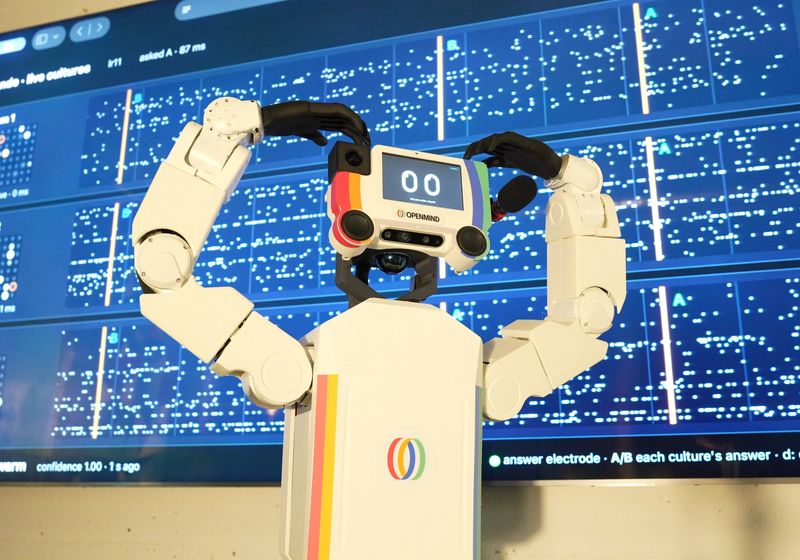
A team led by Jan Liphardt, a bioengineer at Stanford University and founder of OpenMind, has connected a humanoid robot named Iris to living human neurons kept in labs in other countries. The cells were bought as commercial platforms: flat 2D cultures from an Australian company and 3D spheroids from a Swiss one, all grown from induced pluripotent stem cells on electrode arrays.
Iris's cameras sent what she saw to the cells through an API. Electrical spikes from the neurons were turned into outputs and sent back to the robot, so she could tell whether a person was engaged or ignoring her and adjust her behavior. Across nearly 500 simulations, fresh 2D cultures decoded signals with up to 94 percent accuracy in 150 to 240 milliseconds. Spheroids reached up to 91 percent, but with delays of up to two seconds.
Why it matters
The work shows that living neurons can sit inside a robot's control loop. Steve Potter, a neuroengineer not involved in the study, called it an important but very humble first step, since people act in loops of roughly 10 to 100 milliseconds. Liphardt suggests such robots could one day adapt to a family's preferences in a way that is harder to copy or steal. Watch for faster response times and more reliable, scalable setups. Ethics will also stay in focus: Liphardt and Cortical Labs' Brett Kagan say these simple cultures raise no consciousness concerns, but Liphardt says that would change with more elaborate neural structures.