A drone with soft arms folds on impact to squeeze through gaps half its width
Researchers at NTNU and ETH Zurich built a quadrotor whose spring-loaded arms fold when they hit an obstacle and snap back in mid-air, with no folding motors.
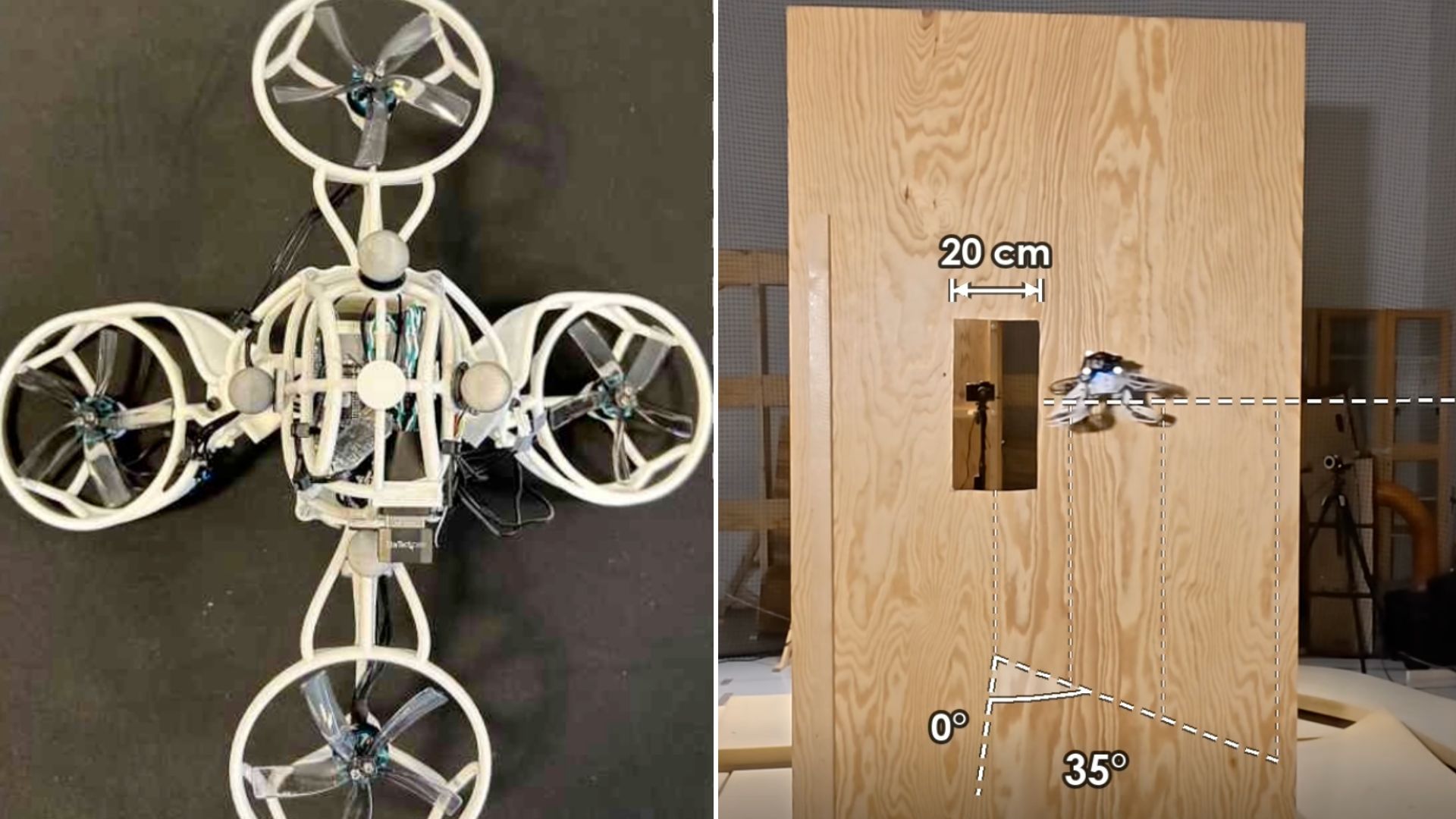
Researchers at the Autonomous Robots Lab of the Norwegian University of Science and Technology (NTNU), working with ETH Zurich, have built a quadrotor with two spring-loaded soft arms that fold passively when they touch an obstacle. There are no folding motors. Each arm pivots on an elastic rolling cam joint, and the shape of the cams sets how stiff the arm is. The prototype is 31.3 centimeters wide in normal flight and collapses to 14.1 centimeters, according to a preprint on arXiv reported by Interesting Engineering.
In flight tests the drone flew straight into a 15-by-20-centimeter opening at 2 meters per second. Contact with the frame folded both arms back; the drone tilted up to 94 degrees and dropped 56 centimeters before the joints snapped the arms out again and it recovered to a hover. It also passed through a 40-centimeter-long tube. Against an identical rigid drone, the soft-armed version added 2 millimeters of tracking error and used less than 1 percent more power in open flight. At approach angles of 35 to 40 degrees off, an arm occasionally dislocated.
Why it matters
Small drones that inspect collapsed buildings, pipework or ventilation shafts either avoid contact slowly or carry heavy motorized folding arms. This design clears gaps 52 percent narrower than its span, against roughly 29 percent for earlier contact-folding quadrotors, at almost no cost in open flight. It is a lab prototype in a preprint, not a product; the team has released its optimization code on GitHub.