Humanoid robot HART learns to drive real vehicles using landmark-based navigation
Researchers built a driving control system for HART, a resizable full-sized humanoid, that steers vehicles by spotting lanes and intersections along a planned route.
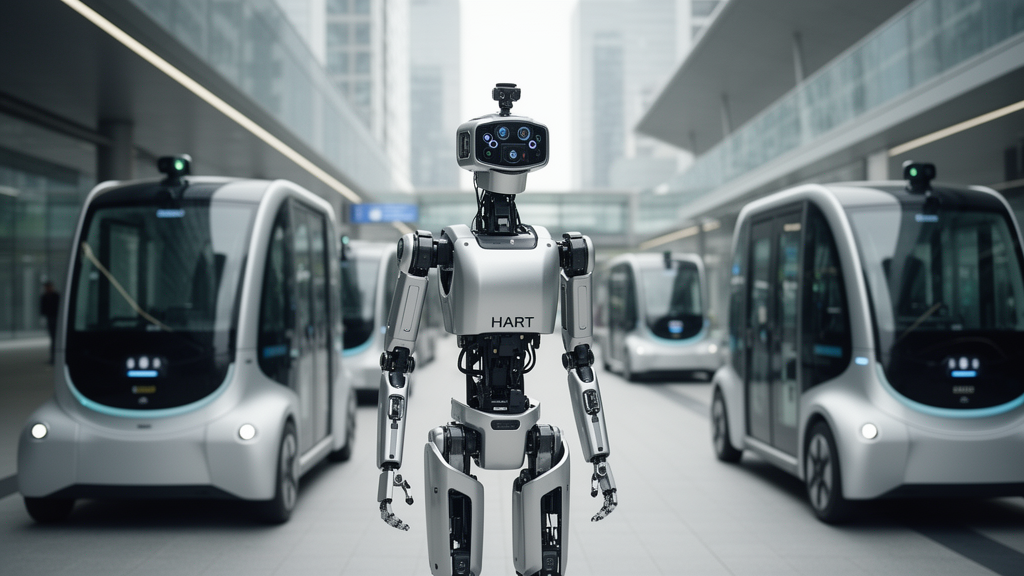
Researchers have developed a control system that lets the full-sized humanoid robot HART, short for Human Assistive RoboT, drive a vehicle on its own. The work, by Yang, Bickford, Esteves, Wisdom and Sohn, appears in the Journal of Intelligent & Robotic Systems. HART is a biped whose body dimensions can be resized, so it can adapt to different kinds of vehicles.
The system works in steps. A planner first draws a guideline route made of waypoints from start to destination. A recognition module then combines that route with satellite positioning (GNSS) data and live camera images to find lanes and intersections. Intersections act as landmarks, and from them the module suggests motions that HART uses to work the vehicle's main controls. A convolutional neural network classifies the intersections, and the team compared several network designs, settings and alternative models while building it.
The complete architecture was tested in experiments in a real-world setting.
Why it matters
Most driving automation is built into the car itself. Here, a humanoid sits in the driver's seat and operates ordinary controls, which could suit vehicles that cannot be modified. The report gives no accuracy figures, speeds, distances or details of the test route, so how well it performs is unclear. Watch for those results in the full paper and for any tests in busier traffic.